How to Tell Whether a Black Friday Deal Is Real
The advice is always 'know the price beforehand'. Nobody explains how. Here's what to record, when to record it, and what counts as a genuine cut.
The short version
A discount is only meaningful against a price the item actually sold at. Retailers routinely raise the reference price before a sale, so the percentage on the sticker measures nothing. Write down what each item you want costs today, weeks before November, and compare the sale price to that, not to the crossed-out number.
Every guide to Black Friday says the same sensible thing: research the price beforehand so you know whether the deal is real.
Almost none of them explain how. And the gap between “know the price beforehand” and actually knowing it is where the whole thing falls down, because the one number you can see in November. The crossed-out price next to the sale price: is the number a retailer chooses.
Why the discount percentage measures nothing
A “was” price is not a historical record. It’s a marketing input. The pattern is well documented and entirely legal in most places: raise the listed price in September and October, then discount from the raised price in November. The sticker says 30% off. The item costs what it cost in August.
This is why the standard advice keeps circling back to price history, and why the tools everyone recommends. The browser extensions and the price-history sites: are all Amazon-shaped. On a large marketplace, somebody else has already recorded the history for you. The moment you’re buying from a furniture brand, a clothing label or a lighting specialist, nobody has.
So on exactly the purchases where the money is largest, you’re on your own.
What “knowing the price beforehand” actually requires
Three things, and only the first one is hard to remember:
A baseline, captured before the sale season. The price on a normal Tuesday in September. This is the number the November price has to beat. Without it you have nothing to compare against and you are, functionally, trusting the sticker.
More than one observation. One number tells you today. Three or four across a couple of months tell you the direction, and the direction is the tell. A price that drifted upward through October is the pattern this article is about.
A record you’ll still have in November. The note on your phone from September does not count, because you will not find it.
What counts as a real cut
Rough thresholds, on the assumption you’ve got a genuine baseline:
- Under 10% off the real price: normal fluctuation on most home and fashion goods. Not a reason to buy.
- 10-20%. A real sale, and about what a decent Black Friday looks like on full-price furniture.
- 20-35%: genuinely good on large items, and usually end-of-line, end-of-season, or a colour they’re discontinuing.
- Over 40% on something current and desirable: worth a second look at whether the baseline was inflated, or whether it’s a floor model, a different spec, or an outlet version of the product you actually wanted.
And two things that aren’t discounts at all: a bundle that includes something you didn’t want, and finance that makes the monthly number small.
The calendar that actually matters
Working back from the last week of November:
- Now, whenever you’re reading this: write down what your five or six wanted items cost today. This is the whole job. Everything else is easy.
- Six weeks out: check again. You’re looking for upward drift.
- Two weeks out. Many retailers start early; the best price is often before the day itself, not on it.
- The week itself: compare to your baseline, not the sticker. Buy the ones that clear your threshold. Walk away from the rest without feeling anything about it.
The last part is the hard one, and having written the numbers down is what makes it possible. A list you made in September, calmly, is a much better decision-maker than you are at 6am on a Friday.
Only track what you’d actually buy
The failure mode of any watchlist is that it becomes a wish list, and then a feed, and then noise. Keep it to items that are:
- expensive enough that a percentage matters: 20% off $12 is not a plan
- already decided. You want this specific thing, you’re only waiting on the number
- not urgent: if you need it in October, there’s nothing to wait for
For most people that’s five to eight things, not fifty.
Doing this in Vurra
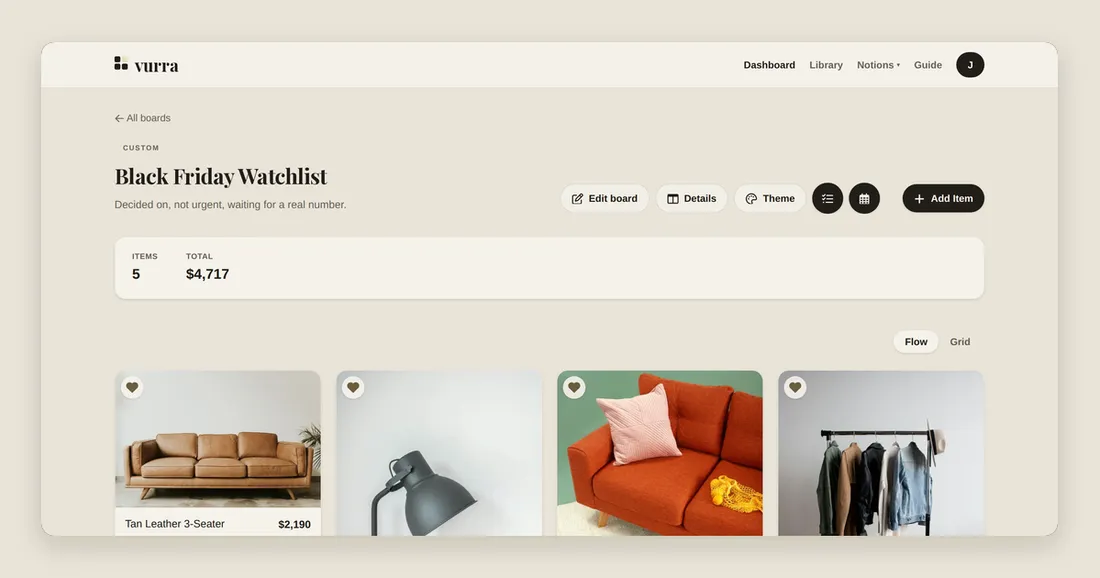
Make a board for the things you’re waiting on and add each one by pasting its product link.
Turn on tracking for each. Vurra records what the item cost at the moment you started watching. That’s your baseline, captured automatically instead of remembered: then re-checks the product page on a schedule and keeps every result. The Price Watch page shows the baseline, today’s price, the lowest it’s been seen, and the shape of the history in between.
That means in November you aren’t comparing the sale price to a crossed-out number. You’re comparing it to what the thing actually cost in September, in October, and last week. If a price climbed before it fell, you can see the climb.
When something drops, you hear about it. When it doesn’t, the row says unchanged, which is most rows most weeks, and is exactly what stops a watchlist turning into a feed.
There’s a cap on how many items you can track at once, on purpose. It is the same argument as the section above: a tracker that watches everything is a marketing channel, not a plan.
More on tracking prices at smaller stores → · See Price Watch →