How Much It Costs to Furnish a House, Room by Room
Published estimates range from $12,000 to $70,000, which is too wide to plan against. Here's how to turn that into a number for your house.
The short version
Furnishing a house typically runs $12,000-$70,000, with a mid-range three-bedroom landing around $22,000-$35,000. The living room is the most expensive room and the bathroom the cheapest. Those ranges are too wide to plan against on their own: build your own number by pricing the five biggest pieces first, then multiplying.
Every article about this gives you a range, and the range is enormous. Twelve thousand dollars to seventy. A mid-range three-bedroom at twenty-two to thirty-five. Premium starting at fifty and going wherever you let it.
Those numbers are real. They’re roughly what published 2026 estimates converge on, but a range that wide isn’t a budget. It’s a shrug. “Somewhere between a used car and a house deposit” doesn’t tell you whether you can afford the sofa you’re looking at.
So here are the ranges, and then a way to turn them into an actual number.
What the published ranges say
Room by room, as a share of a whole-house furnishing budget:
| Room | Typical range | Why it varies so much |
|---|---|---|
| Living room | $4,500-$20,000 | One sofa can be $800 or $6,000 |
| Primary bedroom | $2,500-$16,000 | Bed frame and mattress dominate |
| Dining room | $3,500-$22,000 | Table and six chairs, or a folding table |
| Guest or kids’ room | $1,500-$13,000 | Usually the room people cut |
| Home office | $1,200-$6,000 | Chair quality is the whole spread |
| Bathroom (furnishing, not remodelling) | up to $1,200 | Fixtures are already there |
And by tier, for a whole three-bedroom home:
- Budget, flat-pack and affordable brands: $8,000-$16,000
- Mid-range, a mix of flat-pack and mid-market: $22,000-$35,000
- Premium, designer pieces: $50,000+
Two things to take from this. The living room is consistently the most expensive room, so it’s where a budget is won or lost. And the gap between budget and mid-range is roughly triple, driven almost entirely by a handful of large pieces rather than by the hundred small ones.
Why the ranges can’t be your budget
A range answers “is this normal?” It cannot answer “what will mine cost?”, because the four things that actually decide your number aren’t in it:
- What you already own. Most people furnishing a house are not starting from nothing. Every piece you’re bringing removes a line.
- Which rooms you’re doing now. Almost nobody furnishes a whole house in one go. The real question is usually one or two rooms this year.
- Where your taste sits per category. People are rarely “mid-range” across the board. It’s normal to want an expensive sofa and be entirely happy with a cheap side table.
- Delivery, assembly and the small stuff. Consistently underestimated, and consistently 10-15% on top.
How to build a real number in about an hour
The trick is that you don’t have to price a hundred items. You have to price about five.
Step one: list the big pieces per room. Not everything. Just the items that are individually over a few hundred dollars. In a living room that’s usually four or five: sofa, rug, coffee table, storage, lighting. Everything else is small.
Step two: price each one at the level you actually want. Find a real product you’d genuinely buy and note what it costs. Not a category average. A specific thing with a specific price. This is the step that turns a guess into a number.
Step three: multiply the big-piece total by 1.4. The remaining 40% is everything you didn’t list: cushions, lamps, hooks, a doormat, the second set of sheets. Across many projects that ratio holds well enough to plan with.
Step four: add 10% for delivery, assembly and the thing you forgot.
So a living room with a $1,900 sofa, a $1,240 rug, a $650 chair, a $400 coffee table and a $390 lamp is $4,580 of big pieces → $6,412 with the small stuff → about $7,050 all in. That is a number you can decide about.
The single most useful thing this produces isn’t the total. It’s discovering, before you’ve spent anything, that your taste and your budget disagree, while it’s still cheap to change one of them.
Do it per room, not per house
A whole-house number is demoralising and useless. A per-room number is actionable, because rooms are how you’ll actually buy: one at a time, over months, in an order you choose.
Give every room its own budget and its own list. Then the question stops being “can I afford to furnish this house” and becomes “am I on track in this room”, which has an answer you can check.
Doing this in Vurra
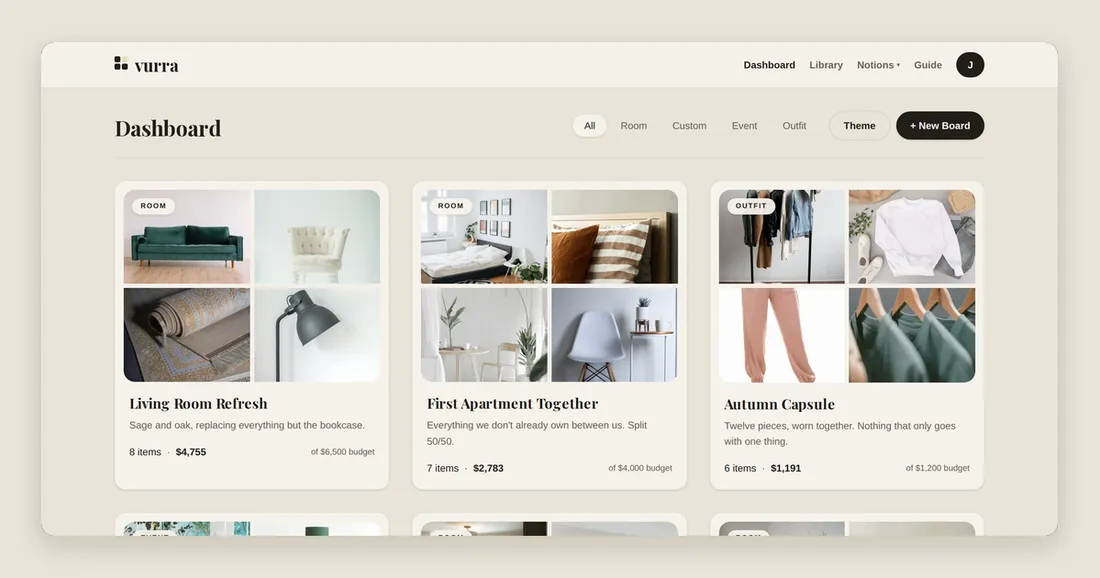
One board per room, each with its own budget.
Add the big pieces first by pasting their product links: Vurra reads the title, price and picture off the page, so pricing five real products takes minutes rather than an evening of copying fields. The board totals as you go, against the budget you set, so you can see immediately whether the room is a $7,000 room or a $12,000 room.
Then keep adding as you find things. Mark items idea, wanted or purchased so the total splits into “what I’ve committed” and “what I’m still considering”. The dashboard shows every room side by side with its own count and its own budget, which is as close as this gets to a whole-house view that’s actually useful.
For the two or three big pieces you’ve decided on but aren’t in a hurry for, turn on price tracking and let the number come to you. On a $1,900 sofa, waiting for a genuine 15% is worth more than every small saving on the rest of the list combined, which is the case made in tracking a price on any store.
See what a board looks like → · Try one without signing up →