Furnishing a First Apartment Without Buying Two of Everything
What you actually need in month one, what can wait, and how to keep track of who's buying what when you're combining two households.
The short version
Start by listing what you already own between you, not what you need. That's what stops the two-blenders problem. Then split the rest into week-one essentials, month-one comfort, and a later layer you shouldn't budget for yet. Record who paid on each item as you buy it, and agree a threshold above which purchases are a joint decision.
The classic outcome of two people furnishing a place together is two blenders, zero spatulas, and a slightly tense first week. It happens because each person is working from a mental list, and mental lists don’t merge.
The fix is boring and it works: one written list, made before anyone buys anything, that includes what you already own between you.
Start with what exists, not what’s missing
Almost every “first apartment checklist” you’ll find online starts with what to buy. Start one step earlier.
Walk both current places and write down the things that are coming with you. Not everything: just the things you’d otherwise buy twice. In practice that’s a short list and it’s always the same categories:
- Kitchen: kettle, toaster, microwave, pans, knives, can opener
- Cleaning: vacuum, iron, drying rack, mop and bucket
- Bedroom: bedding sets, pillows, hangers
- Living: TV, lamps, a coffee table someone’s had since college
- Tools: drill, screwdrivers, tape measure, step stool
Then mark anything you have two of. Some of those you should keep two of. You’ll want more than one lamp, and some are pure duplication you can sell before the move rather than move and then sell.
The month-one list
The rest of the list splits cleanly into three tiers, and the mistake is treating them as one.
Week one. You can’t live without these. Bed and bedding. Somewhere to sit. Shower curtain and towels. Toilet paper and cleaning basics. One pan, one pot, a knife, a cutting board, two of each plate/bowl/glass/fork. Trash can. Light in every room you use at night. A drill, or a very patient friend with one.
Month one: quality of life. Dining table and chairs. Dresser or wardrobe storage. A real sofa if week one was a folding chair situation. Curtains or blinds, particularly if you’re on a ground floor. Laundry basket, drying rack. A desk if either of you works from home.
Later. The layer that makes it yours. Rugs. Art. Shelving. The good cookware. Plants. The chair nobody sits in but everyone photographs.
Budget the first two tiers. Do not budget the third one yet; you don’t know the apartment well enough. Live in it for six weeks and you’ll make different choices than you would have on day three.
A realistic first budget
Numbers vary enormously by city and by how much you’re bringing, but the shape holds:
| Tier | Share of setup budget | Why |
|---|---|---|
| Week one essentials | 40% | Unavoidable, and mostly small items that add up fast |
| Month one comfort | 45% | The big-ticket pieces: table, sofa, storage |
| Contingency | 15% | Deposits, delivery, the thing that doesn’t fit |
Two things people consistently underestimate: small kitchen items (fifty dollars of small things per trip, four trips) and delivery and assembly on anything large. Both belong in the budget as line items rather than surprises.
Tracking who’s paying for what
If you’re splitting costs, decide the rule before you shop, because retroactive fairness arguments are the worst kind:
- Straight 50/50 works when incomes are similar and everything is shared.
- Proportional, where each pays a share matching their income, works when they’re not.
- “You buy the sofa, I’ll buy the table” is easiest to execute and hardest to keep even. It works if you square up at the end.
Whichever you pick, record who paid on each item as you go. Not in a separate expense app: on the item itself, next to its price. The moment those two facts live in different places, reconciling them becomes a chore, and chores don’t get done.
Agree a threshold above which purchases are a joint decision. $200 is a common one. Below it, either of you just buys the thing; above it, you talk first. It removes an entire category of argument.
Doing this in Vurra
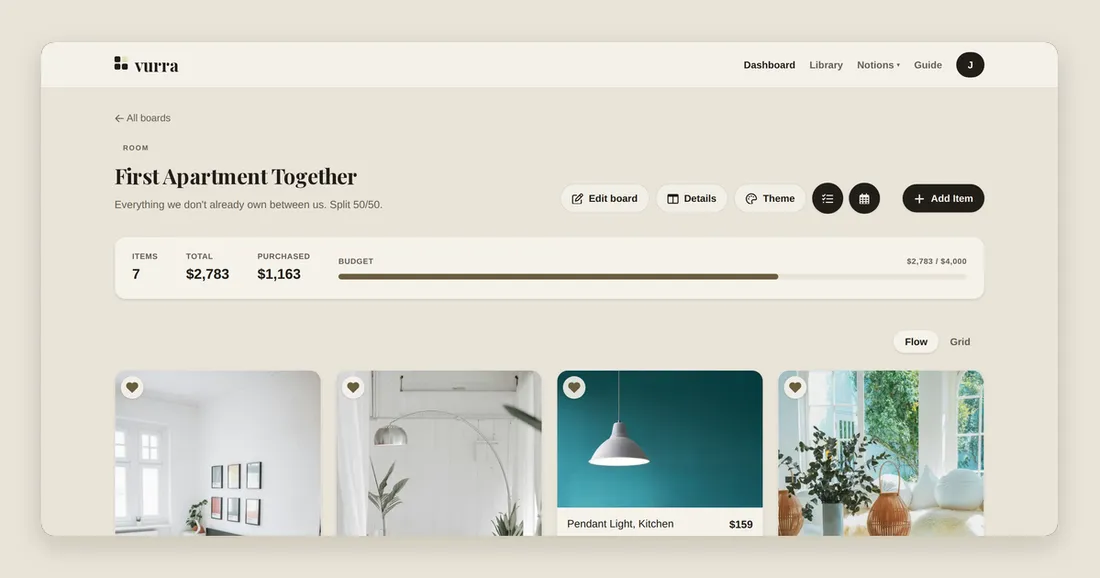
One board for the apartment, with the setup budget on it. Add every item you need: pasting a product link fills in the title, price and photo, and use status to carry the tiers: idea for the “later” layer, wanted for what you’re actively buying, purchased for what’s done.
Then add the fields that make it a shared plan rather than a shopping list: a Paid field (Split / one name / the other), a Room field if you want to sort that way, and Size on anything that has to fit through a doorway.
The board totals as you go, so you can see the setup budget draining in real time rather than discovering it afterwards. The things you already own between you can go on as purchased at $0. They’re then on the list, visibly handled, and nobody buys a second one.
Add the move-out and move-in dates, and the tasks that hang off them: book the van, return the duplicate kettle, agree the split on anything over $200, and they sit alongside the shopping rather than in a separate app.
One thing to know: Vurra boards are single-user right now. Shared editing isn’t built yet, so in practice one of you keeps the board and the other looks over a shoulder. The Paid field still does the work of tracking who owes what.