How to Organize Gift Shopping for the Whole Year
Stop starting from zero every December. A running list, a per-person budget, and the dates that matter: set up once and used all year.
The short version
Stop restarting every December. Keep one running list per person, all year, and add ideas the moment someone mentions something: capture has to take under ten seconds or it won't happen. Set a per-person budget before you total them up, and work backwards from order deadlines rather than from the occasion itself.
Gift shopping is the only recurring project most people restart from scratch every single time. You spend December reconstructing what you already knew in March. That your sister mentioned a specific kind of coffee grinder, that your dad needs new walking boots, that the thing you got last year went down badly.
None of that is hard to keep. It’s just that the moment you learn it is never the moment you’re shopping.
Capture beats planning
The single highest-value habit here isn’t budgeting or list-making. It’s writing things down at the moment someone tells you.
People broadcast what they want constantly and incidentally: “mine’s finally died,” “I keep meaning to replace this,” “I’ve wanted one of these for ages.” Those sentences are worth more than an hour of December browsing, and they evaporate within a day.
So the first requirement of a gift system is that adding something takes under ten seconds from a phone, in a hallway, while someone is still talking. If it takes longer than that, you won’t do it, and the system is worthless no matter how well designed the rest of it is.
One list, all year, grouped by person
Not a list per occasion. A list per person, running continuously.
Occasions come and go; the person is the constant. When your sister’s birthday arrives, you want to see the four things you noted since last year, not start a new document. And when Christmas arrives, you want the same list minus whatever you already gave her in June.
For each entry, keep it light:
- What it is, with a link if you have one
- Roughly what it costs
- Who it’s for
- Where the idea came from: “said hers broke, March”, because in eight months you won’t remember whether this was their idea or yours
- Status: idea / decided / bought
The “where it came from” field is the one that turns a list of products into something that actually helps. An idea you noted because they said it is a much better bet than one you found while browsing.
Set per-person budgets, then a total
Most gift overspend comes from the same mechanism as room-budget overspend: every individual gift is defensible, and nothing is counted against anything else until it’s over.
Set a per-person number first, then check what they total to. If the total is too high, you adjust deliberately, rather than discovering in January that “about $50 each” turned into $900 across seventeen people.
A pattern that works: three tiers. Close family at one number, wider family and close friends at a second, and a small standing amount for the teacher/neighbor/host category that always appears and is never planned for.
Include the invisible costs. Shipping, wrapping, cards, and postage are routinely 10-15% on top and never make it into the budget.
Work backwards from the dates
The dates are the part people get wrong, because the deadline isn’t the occasion. It’s the last day you can order and still have it arrive.
Working backwards from any gift-giving date:
- Handmade or personalized: 4-6 weeks. Engraving, printing and custom fulfillment queues get long exactly when you need them.
- International shipping: 3-4 weeks, more in December.
- Standard online orders in peak season: 2 weeks to be safe.
- Anything from a small independent shop: longer than you think. One person may be packing every order.
Put those deadlines in as their own dated entries. “Christmas” is not an actionable date. “Last order date for anything personalized” is.
The December method
If you’ve captured all year, December is short:
- Filter to unbought ideas, grouped by person.
- Anyone with three or four ideas: pick one, mark it decided.
- Anyone with none. Those are your only real shopping problems. Usually two or three people, not seventeen.
- Order everything with a lead time first, on the same day.
- Then the rest, in one or two sessions.
The reason this works isn’t organization for its own sake. It’s that you’ve converted a large vague task into a small specific one, and small specific tasks get done.
Doing this in Vurra
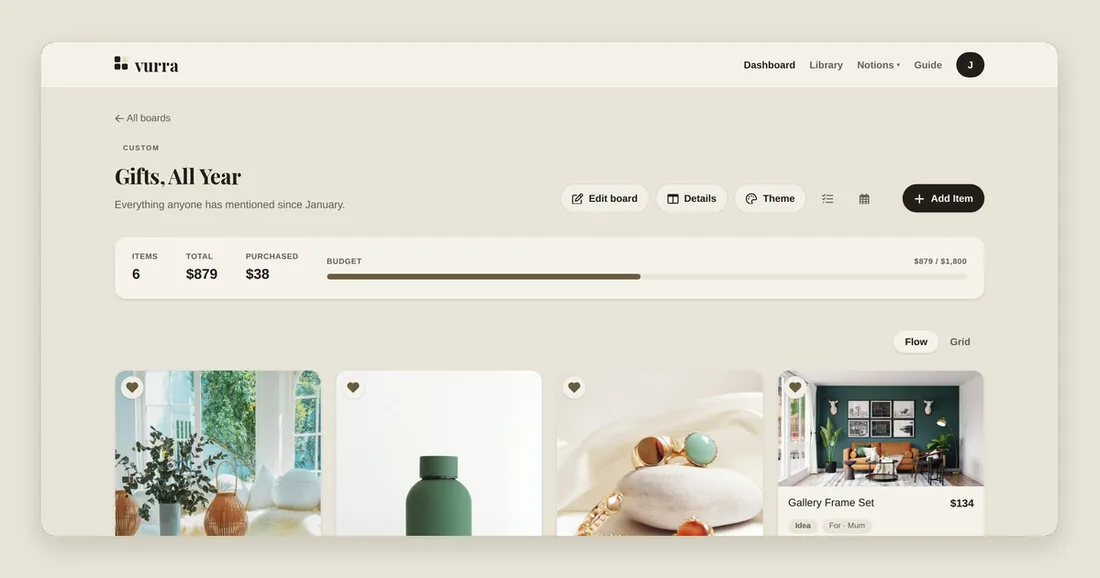
A single board for gifts, running all year, with a budget on it.
Add ideas the moment you hear them: paste a link and Vurra fills in the title, price and photo, which is what makes the ten-second capture possible. Add a For field with the person’s name, and a Heard field for where the idea came from. Set status as you go: idea while it’s a maybe, wanted once you’ve decided, purchased once it’s ordered.
The board totals against your budget as you add things, so the per-person plan and the overall number stay visible in the same place.
Use Dates for the occasions and, more importantly, for the order deadlines that sit two to six weeks before them. Use Lists for the tasks that aren’t purchases: wrap the parcels, write the cards, post the international ones.
For anything expensive you’ve decided on but haven’t bought, turn on tracking and let it wait for a better price. Gifts are the ideal case for this: you know exactly what you want and you have months of slack. That’s the whole argument in tracking a price on any store.
Then next year you don’t start from zero. You start from a board with forty things on it and a very short list of people you still need an idea for.