Moving In: What to Buy When
A sequence, not a checklist. What has to be there on day one, what can wait a month, and which orders you have to place before you move at all.
The short version
Most moving lists tell you what to buy but not when. The order matters more than the list: place long-lead orders before you move, buy only day-one essentials in the first week, wait six weeks before choosing anything decorative, and work backwards from delivery windows rather than forwards from move-in day.
There are hundreds of moving checklists and they are all roughly the same list. Cleaning supplies, shower curtain, a pan, a bed. The list is not the hard part.
The hard part is the order, because two things on that list have eight-week lead times, three of them can’t be chosen until you’ve lived in the place, and one of them has to be ordered before you’ve even moved.
A checklist treats every item as equally urgent. A sequence doesn’t.
The one thing to do before you move
Order anything with a lead time longer than the gap between now and move-in.
Upholstered furniture is routinely six to ten weeks. Made-to-measure blinds are three to six. Mattresses, appliances and anything in a specific finish can be weeks out. If you wait until you have the keys to order a sofa, you are choosing to sit on a folding chair until roughly Christmas.
The uncomfortable part is that this means committing to a sofa for a room you don’t live in yet. The honest resolution: order the large, structural, hard-to-change things early: sofa, bed, dining table, and leave everything decorative until later. Those are the pieces whose dimensions you can plan from a floor plan, and whose colour you’ll be happiest keeping neutral anyway.
Week one: only what makes the place habitable
The test for week one is not “do I want this” but “can I sleep, wash, eat and see”.
- Bed, mattress, one set of bedding, pillows
- Towels, shower curtain, toilet paper, soap
- One pan, one pot, a knife, a board, two of each plate/bowl/glass/fork
- Bin and bin bags, cleaning basics
- A light in every room you use after dark
- Somewhere to sit that isn’t the floor
- A drill, or a friend who owns one
That’s it. Everything else can wait a week without costing you anything.
Do this in week one too, before decor: change the locks, test every smoke and carbon-monoxide alarm, and find the water, gas and electrical shut-offs. It takes an afternoon and it is the only part of this list that is about safety rather than comfort.
Month one: the things that make it work
Now you know where the light falls and which doors don’t open fully.
- Dining table and chairs
- Storage: wardrobe, dresser, shelving
- Curtains or blinds, especially at ground level
- Laundry basket, drying rack, iron
- A desk, if anyone works from home
- The second set of everything you’ve been washing daily
This is also when the early orders start arriving, which is the payoff for the step at the top.
Month three and after: the layer that makes it yours
Rugs, art, plants, lamps beyond the functional ones, the good cookware, the chair nobody sits in.
Do not budget this yet. Not because it doesn’t matter. It’s the layer that makes the place feel like yours, but because six weeks of living somewhere changes your mind about it comprehensively. Everyone who buys the rug in week one buys a second rug in month four.
Work backwards, not forwards
The instinct is to plan forwards from move-in day. The dates that actually constrain you run the other way:
| Thing | Order by | Why |
|---|---|---|
| Upholstered furniture | 8-10 weeks before you need it | Made to order, and the queue lengthens toward Christmas |
| Made-to-measure blinds | 4-6 weeks | Measuring, then manufacture |
| Mattress | 2 weeks | Some are next-day; a specific one usually isn’t |
| Appliances | 2-3 weeks | Delivery slots, and installation is separate |
| Anything from a small maker | Longer than you think | One person may be building it |
Two extra dates people forget, and both cost money: the day your utilities need to be in your name, and the last day you can cancel a delivery without a fee: worth knowing before the sofa arrives at the old address.
A budget shape that works
Split the setup budget three ways rather than treating it as one pot:
- 40%: week one essentials. Mostly small items, and they add up much faster than anyone expects.
- 45%: month one. This is where the big pieces sit.
- 15%: contingency. Delivery surcharges, the thing that doesn’t fit through the door, the second trip to the hardware shop.
If you want a fuller method for the furniture half of this, that’s how much it costs to furnish a house. And if you’re combining two households rather than starting fresh, start with furnishing a first apartment instead. The first job there is listing what you already own between you.
Doing this in Vurra
One board for the move, with the setup budget on it.
Use status to carry the sequence rather than keeping three separate lists: purchased for what’s ordered, wanted for this month, idea for the later layer. The board totals as you go, and the split between purchased and total tells you what you’ve actually committed versus what you’re still considering.
Add a field of your own for when: Week 1, Month 1, Later, and one
for lead time on anything made to order. Lead time next to price is the
combination that makes the ordering decision obvious, and it’s the pairing no
generic list gives you.
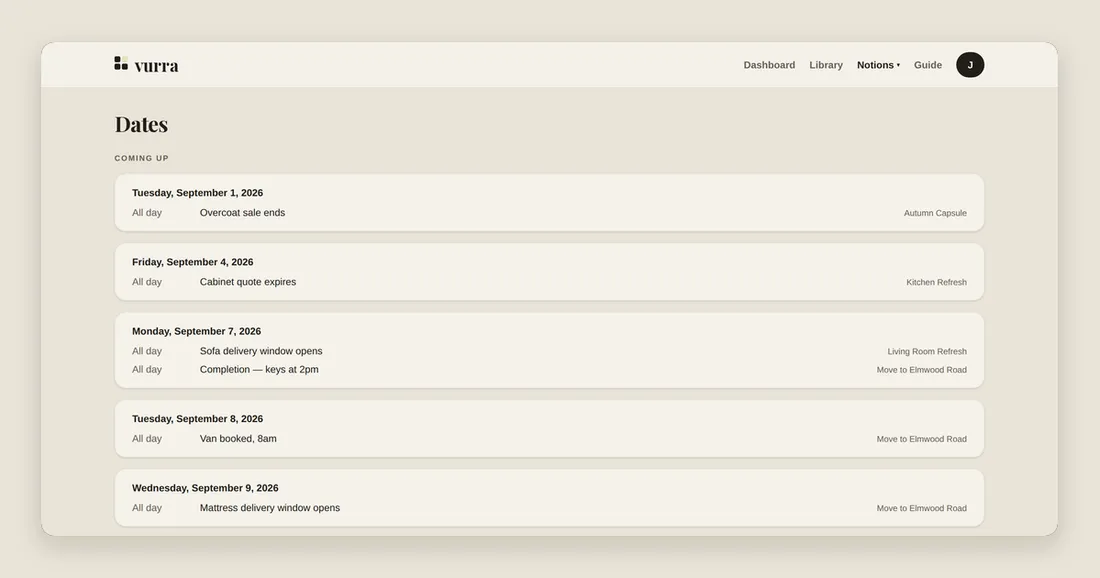
Then put the real dates in Dates: completion day, the van, each delivery window, the day the utilities switch. Not “move” as one entry. The individual deadlines, because those are the ones you can act on. Put the tasks that aren’t purchases in Lists: measure every window before ordering blinds, confirm the completion date, redirect the post.
All of it sits against the shopping instead of in a separate app, which is the only reason any of it gets looked at in a week when you are moving house.
Worth knowing: Vurra boards are single-user right now. If two of you are moving, one keeps the board. A Paid field still does the work of tracking who bought what.