How to Plan a Room Makeover Shopping List Without Blowing the Budget
A practical method for furnishing a room: how to split the budget before you shop, what to record for each piece, and the order to buy things in.
The short version
Room budgets are blown by eleven reasonable purchases, not one extravagant one. Split the budget by category before you shop, record dimensions, lead time and store alongside each price, and buy in order of size and inflexibility: seating first, then the rug, then tables and storage, then lighting, then textiles and art last.
Most room budgets aren’t blown by one extravagant purchase. They’re blown by eleven reasonable ones.
You decide on $6,500 for the living room. The sofa is $1,899, which feels fine against $6,500. The rug is $1,240, also fine. The chair is $649: fine. Every individual decision is defensible, and you end up at $8,200 because nothing was ever counted against anything else at the moment you were deciding.
The fix isn’t discipline. It’s doing three things before you start shopping.
1. Split the budget before you shop, not after
Give every category a share of the total up front. You will be wrong, and that’s fine. The point is that when the rug comes in at $1,240 against a $900 line, you find out immediately and consciously, instead of finding out in November.
A rough starting split for a living room, as a share of the furnishing budget:
| Category | Share | On a $6,500 budget |
|---|---|---|
| Seating (sofa, chairs) | 35-40% | $2,300-2,600 |
| Rug | 15-20% | $1,000-1,300 |
| Tables (coffee, side) | 10-15% | $650-975 |
| Lighting | 10% | $650 |
| Storage / shelving | 10% | $650 |
| Textiles, art, small things | 10-15% | $650-975 |
Two notes on this. The seating share looks large until you price sofas; it is the piece you sit on every day and the one people regret cheaping out on most. And the last row is the one that eats budgets: “textiles, art and small things” is where eleven reasonable purchases hide, because none of them feel like a decision.
Hold back 10%. Not for emergencies, for the thing you haven’t thought of. There is always one: the rug pad, the delivery surcharge, the lamp that needs a different bulb, the curtain rod. If you finish without spending it, you finish under budget, which is a nice problem.
2. Record more than a price
For each piece, the price is the least useful thing you’ll want later. Record these too, and you’ll avoid most of the ways a room goes wrong:
- Dimensions, and the dimension that matters. Not just “84 inches” but “84 inches: clears the alcove by 3”. Width is a number; fit is an answer.
- Lead time. A six-week sofa and a two-day rug are different purchases even at the same price, because one of them decides your delivery order.
- Where it’s from. Returns, delivery terms and sale calendars are all per-store, and you will want to group by store later.
- Status. Whether this is an idea, a decision, or something already bought.
- The link. To the exact product page, not the category page. Future you will need the variant.
This is the part people try to hold in their head and can’t. Eleven items × five facts is fifty-five things, and the one you forget is always the measurement.
The single most useful field is the one nobody thinks to add: the reason you rejected something. Six weeks in you will reconsider a chair you already ruled out and have no memory of why.
3. Buy in the right order
Order matters more than people expect, because early choices constrain later ones.
- The biggest, least flexible piece first. Usually seating. It’s the largest share of the budget, the longest lead time, and the thing whose color everything else has to live with.
- The rug second. It sets the palette for the floor and it’s easier to find a rug that works with a sofa than a sofa that works with a rug.
- Tables and storage third. These are the pieces with the most options at every price point, so they’re where you absorb budget overruns from steps 1 and 2.
- Lighting fourth. Cheap to change later, and you’ll understand the room’s dark corners better once the big pieces are in.
- Textiles, art and small things last. They’re the adjustment layer. Buying them early means buying twice.
The exception: if something has a long lead time, order it in its slot regardless of where it sits in this list. A four-month backordered chair bought last arrives after you’ve stopped caring.
4. Know when to wait
Furniture and home goods have real sale cycles, and the pieces worth waiting for are the expensive, non-urgent ones:
- Rugs and large furniture discount around major holiday weekends and at end-of-season clearances.
- Bedding and linens have had “white sales” in January for about a century.
- Outdoor furniture is cheapest at the end of summer, obviously and reliably.
The problem is knowing whether a given “sale” is real. A price you saw once three months ago isn’t a baseline, and a retailer’s own struck-through “was” price isn’t evidence. What you need is the history of what that item has actually cost.
Doing this in Vurra
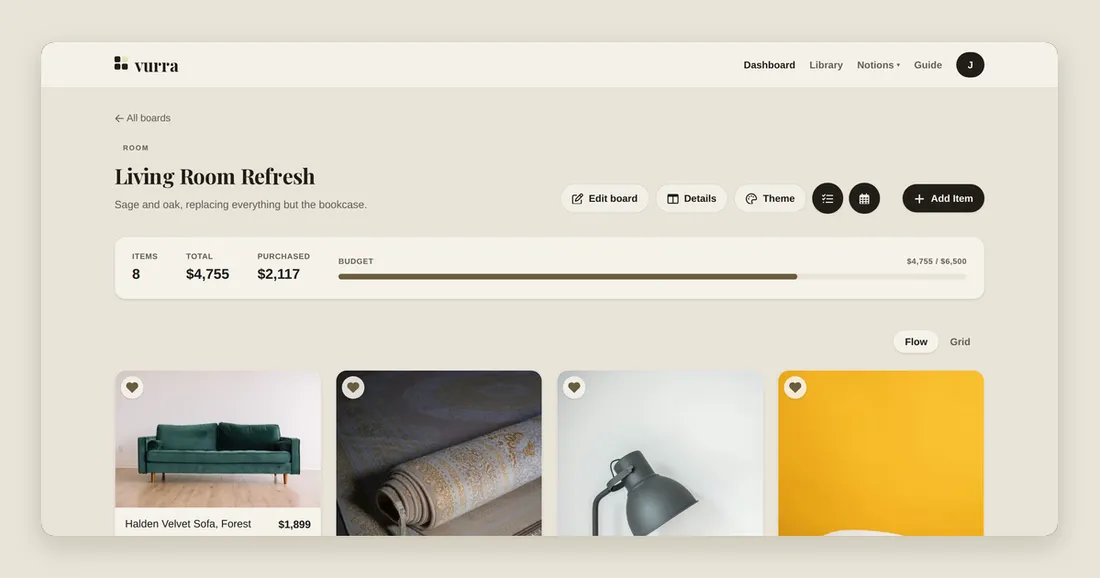
This is more or less exactly what a Vurra board is for.
Make a board for the room and set its budget. Add each piece by pasting its product URL: Vurra pulls the title, price and photo, so you’re not typing five fields per item. Add the fields this project needs: Width, Lead, Store, and whatever else. Mark things as idea, wanted or purchased as you go.
The board keeps a running count for you: items, total, how much you’ve already spent, and where that sits against the budget. The tiles stay visual, so you can still see whether the room hangs together, which is the part a spreadsheet never gives you.
For the two or three pieces you’re waiting on, turn on Price Watch. Vurra checks their prices, keeps the history, and tells you when something drops, so “wait for the sale” becomes a thing that happens to you rather than a thing you have to remember to check. More on that in tracking a price on any store.
And the measurements, lead times and rejected-because notes all live on the item they belong to, which is the only place you’ll think to look for them.