Turning a Mood Board Into Things You Can Actually Buy
A folder of images is where a room starts and where most rooms stop. The step from inspiration to a list with prices on it is a specific piece of work, and it is where nearly everyone stalls.
The short version
A mood board records a feeling; a purchase needs a size, a price and a delivery date. Bridge them by naming what each saved image is actually telling you: a colour, a material, a shape, or a specific object. Only the last is shoppable, and the rest become criteria you judge real products against.
Almost every room begins as a collection of images. A Pinterest board, a folder of screenshots, a few pages torn out of something. This part is enjoyable and everybody is good at it.
Then the room has to be bought, and the collection turns out to be almost useless for that, because a photograph of somebody else’s living room is not a list of things with prices.
What each image is actually telling you
The bridging step is to go through the images and name what each one is doing. There are only four answers, and separating them is most of the work.
A colour. You saved it for a wall shade, a green, the warmth of the light. Not shoppable, but a criterion: every real product you consider gets judged against it.
A material or texture. Oak rather than walnut, boucle rather than velvet, brass rather than chrome. Also a criterion, and a strong one, because material is the thing that most reliably makes a set of objects from different shops look like they belong together.
A shape or proportion. A low sofa, a round table, thin legs. This is the hardest to articulate and the most decisive. Try to write the sentence: “the sofas I like are low with a visible frame.”
An actual object. Occasionally you have saved a specific purchasable thing. This is the only category that is directly shoppable, and it is a much smaller share of any mood board than people expect, usually one or two images in twenty.
Turn the first three into criteria
Once separated, the criteria become a short list you can hold in your head while shopping. Something like: warm oak, low and visible-framed seating, brass rather than chrome, one deep green.
Four criteria. That is enough to reject three quarters of what you will see, which is exactly what you need, because the problem with furniture shopping is never a shortage of options.
Write them into the board’s description so they are visible every time you add something. A criterion you cannot see while shopping is a criterion you are not applying.
Then shop against them, in one place
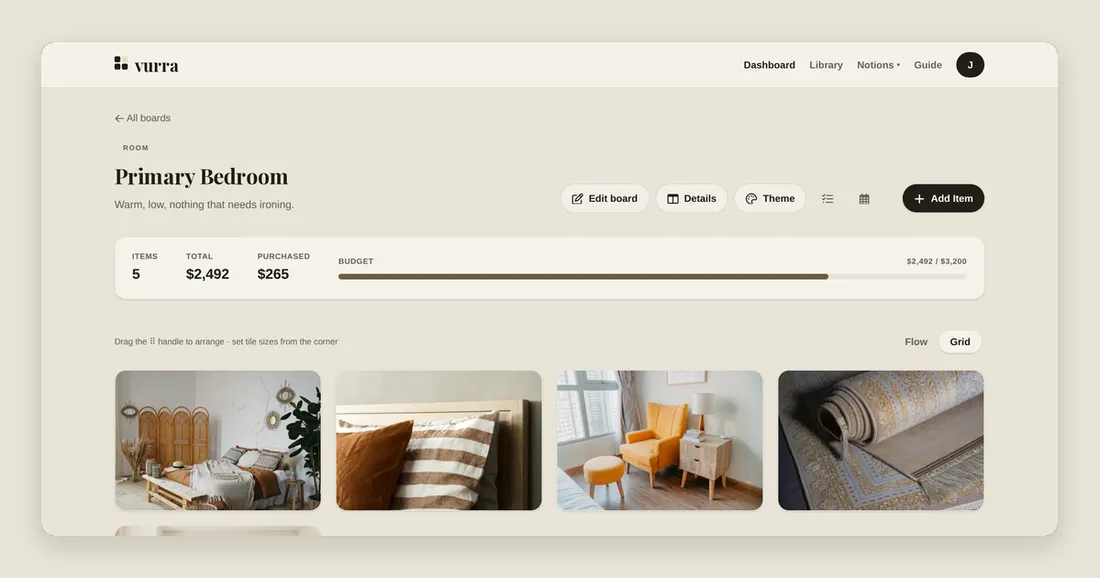
Here is where the mood board and the shopping list stop being separate objects. Each real product you consider is added with its picture, its price, its width, its lead time. The picture means it still functions as a mood board; the fields mean it also functions as a plan.
That is the whole trick, and it is why doing this in two tools does not work. A Pinterest board that knows nothing about price and a spreadsheet that shows no pictures each hold half of the decision, and the reconciliation between them happens in your head, badly, at eleven at night.
Keep the rejects
When something fails a criterion, rule it out rather than deleting it, and write the reason. Two months later, in a sale, you will see it again and feel the pull, and “too high, wrong legs” is worth having.
It also sharpens the criteria. After ten rejections with reasons attached, you usually discover that your real criterion was narrower than the one you wrote, and you can correct it.