Furnish a Room in This Order and It Will Cost Less
Rooms go wrong when they are bought in the order things catch your eye. There is a sequence that produces a coherent room for less money, and it starts with the thing nobody photographs.
The short version
Buy the rug and the largest seating first, because they set the colour and the scale everything else has to work with. Lighting third. Small decorative pieces last, once you can see what the room is short of. Buying the small things first is what produces a room of items that do not agree.
There is a version of furnishing a room where you buy the things you like as you find them, and end at a room full of individually good objects that do not look like anything together.
It is extremely common and it is a sequencing problem, not a taste problem. Almost everybody involved has perfectly good taste. What they do not have is a constraint applied early enough for the later purchases to be judged against.
The sequence
1. The rug, or the floor. This sounds like the wrong place to start and it is the right one. A rug is the largest area of colour in most rooms, it is underneath everything, and it is the hardest thing to change later. It sets the palette. Choosing a sofa first and then hunting for a rug that works with it is a much smaller search space than the other way round.
If the room has no rug, the floor plays this role, and you already own it.
2. The largest seating. The sofa, or the bed, or whatever the room’s single biggest object is. This sets the scale, and scale is where rooms most visibly go wrong: a sofa fifteen centimetres too long makes everything else in the room look wrong and nobody can say why.
Measure the wall, then subtract. A sofa that fits exactly is a sofa that looks wedged.
3. Light. Before the tables, before anything decorative. Lighting does more for how a room feels than any other purchase at its price, and it is consistently bought last, out of what is left.
Two or three sources at different heights, not one on the ceiling.
4. The supporting pieces. Side tables, a coffee table, storage. These are judged against the three groups above, which is much easier than judging them against nothing.
5. Everything small. Cushions, prints, objects. Last, once the room exists and you can see what it is short of. Bought first, these are guesses. Bought last, they are answers.
Why the order saves money
Two mechanisms.
The first is that later purchases get judged against a defined thing rather than an imagined one, so fewer of them are wrong, and returning large furniture is expensive and often impossible.
The second is subtler: rooms bought in this order need fewer objects. A room where the rug, the seating and the light are right feels finished with very little else. A room where those three are wrong needs an accumulation of small purchases trying to fix it, and they never quite do.
The measurements to carry
| Field | Why it earns a column |
|---|---|
| Width | Whether it fits the wall, with the gap it needs on each side. |
| Lead time | Sofas are eight to twelve weeks. It decides what you order first. |
| Colour name | Two shops calling something oatmeal does not make it the same oatmeal. |
| Returns window | Often shorter on large furniture, and it starts on delivery. |
Seeing the room before it exists
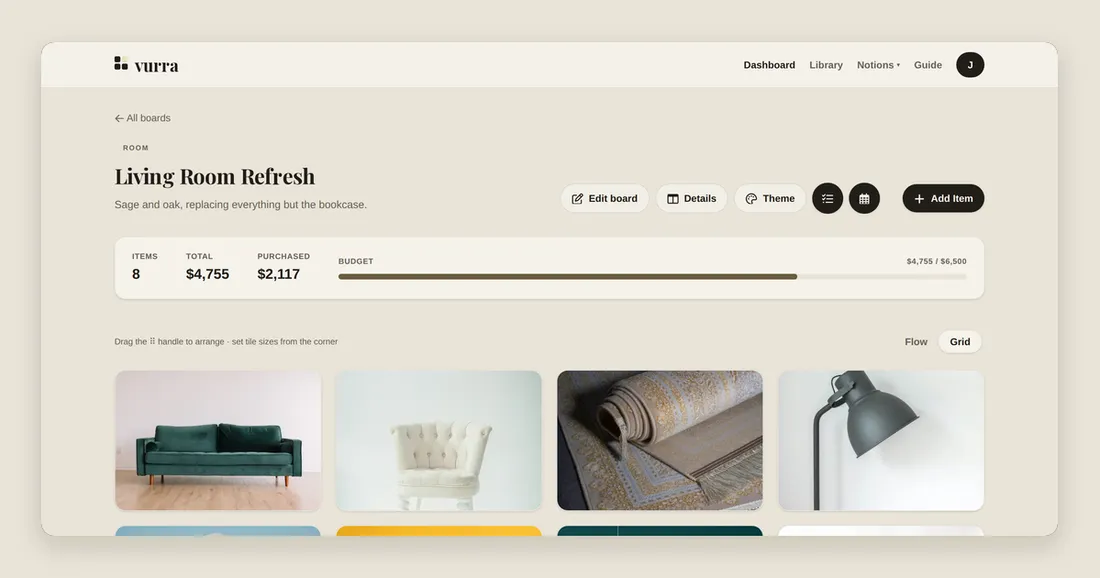
The reason this works better on a board than in a spreadsheet is that steps one through three are visual judgements about how three large objects sit together, and a spreadsheet cannot show you that.
Put the candidates on one board, switch to a grid, and the question “do these three agree” answers itself. The budget sits alongside, so you can see what the rug and the sofa have left for everything after them, which is the number that governs the rest of the sequence.