Splitting Furniture Costs When You Move In Together
Furnishing a flat together is the first joint financial decision most couples and housemates make, and the arrangements that cause arguments later are the ones nobody wrote down.
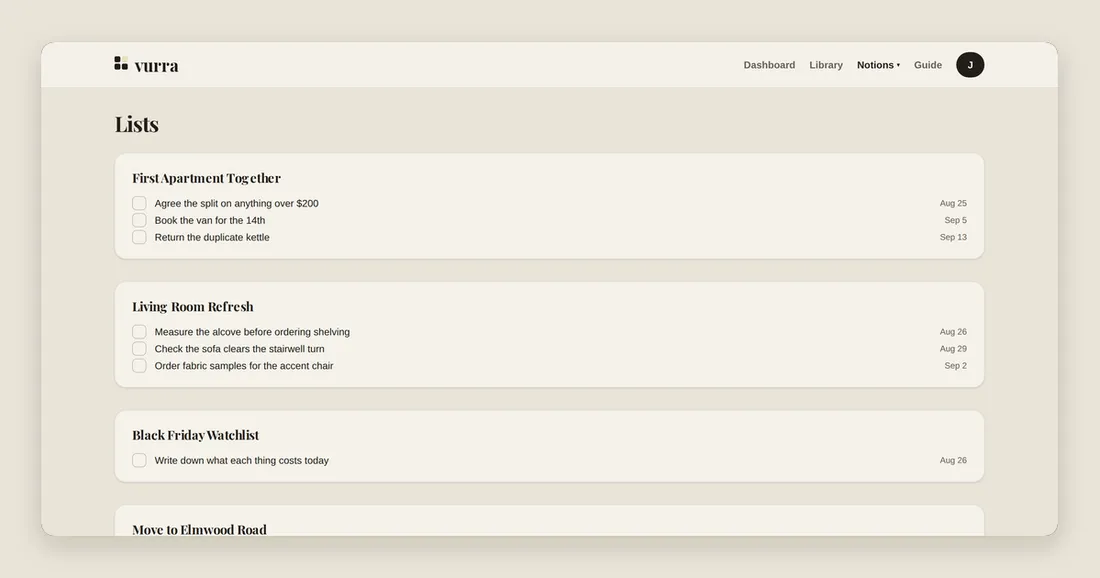
The short version
Decide before buying anything who owns what if you separate. The workable options are: split everything and split proceeds, each buy specific items outright, or one buys and the other pays rent-free equivalent. Record which applies per item. The arrangement matters far less than having agreed one.
Furnishing a flat with somebody is usually the first significant joint purchase a couple or a pair of housemates makes, and it is made at the least convenient possible moment: during a move, under time pressure, when both people are stressed.
It nearly always works out. When it does not work out, the reason is almost never the money. It is that nobody said out loud what the arrangement was, so two people each formed a reasonable and different impression of it.
Three arrangements that work
Split everything, split the proceeds. Every item is bought jointly, and if you separate you either sell and split or one person buys the other out at a depreciated value. Simple, fair, and requires you to actually do the buying-out conversation rather than avoiding it.
Each person buys specific items outright. You take the sofa and the bed, they take the table and the white goods. Everything is owned by one person, clearly, from the start. This is the least romantic option and by a distance the easiest to unwind.
One buys, the other contributes differently. Common where incomes differ a lot. One person funds the furniture, the other covers a larger share of rent or bills for a period. Works fine as long as the period is defined and the furniture ownership is stated.
Any of these is fine. The failure mode is having no arrangement, and then discovering eighteen months later that one of you thought the sofa was joint and the other remembers paying for it.
Have the conversation before the shopping
It is much easier to agree a principle in the abstract than to litigate a specific sofa. Ten minutes before you start looking is worth several hours afterwards.
The question to actually ask is not “how do we split this” but “if we were not living together in two years, what happens to this stuff”. People answer that one honestly, because it is hypothetical.
Record it per item, not as a policy
This is the practical bit. A policy written down once is forgotten. A field on each item is looked at every time anybody opens the board.
| Field | What goes in it |
|---|---|
| Paid by | Whose money actually bought it. |
| Owned by | Who keeps it. Not always the same as who paid. |
| Split | The percentage, where it is genuinely joint. |
Three fields. The reason to keep them on the item rather than in a shared note is that the item is where you are already looking when the question arises.
The awkward categories
The bed and mattress. Bought jointly, kept by nobody comfortably. Most people treat this as consumed rather than owned, which is realistic.
Anything one person cared about much more. If one of you chose the sofa and the other was indifferent, that should be reflected in the ownership even if the money was split, because indifference now is resentment later.
Gifts from one family. These are usually the other person’s family’s gift to both of you, and treating them as jointly owned is the generous reading and the one that causes the fewest problems.
Why a shared board rather than a spreadsheet
Because both of you need to be looking at the same thing, and because half of these decisions are visual. Share the board as an editor rather than mailing a sheet back and forth, and put a poll on the sofa when there are three candidates and two opinions.
The record of who paid for what then lives in the same place as the picture of the thing, which is the only place either of you will look for it.