The First Night Box: What a First Apartment Needs in the First Twelve Hours
A first apartment list has about sixty items on it and they are not equally urgent. Here is the small group that has to exist before you sleep there, and why everything else can wait.
The short version
Before the first night you need somewhere to sleep, a way to wash, a way to make a hot drink, light in the rooms you will use, and the tools to assemble anything flat-packed. Everything else can wait a week without costing you anything. Buying in that order is what keeps a first apartment affordable.
The problem with a first apartment list is not that things are missing from it. It is that everything on it looks equally urgent when it is written as a list, and it is not. A mattress and a vegetable peeler occupy one line each.
Sorting by urgency rather than by category is the single change that makes the whole thing affordable, because it lets you buy the first group properly and the last group slowly.
The first night
Somewhere to sleep. A mattress, and something to put it on if you have it. This is the one thing that cannot be improvised for even one night without consequences, and it is worth buying at the top of what you can afford, because you will use it eight hours a day for a decade.
Bedding. A duvet, a pillow, one set of sheets, one towel. Two of nothing.
Light. Rented flats frequently come with bare fittings and no bulbs. Check this before moving day, because discovering it at seven in the evening means sitting in the dark in a flat full of boxes.
A way to make a hot drink. A kettle and one mug. This is not a joke item. The first evening in an empty flat is a strange one and a cup of tea does a surprising amount of work.
Toilet paper, soap, a bin bag. The things nobody writes down.
A tool kit. Whatever is flat-packed has to be assembled that night, and the allen key in the box is designed to make you regret relying on it. A basic set with a real screwdriver and a hammer.
That is the list. Eight things.
The first week
Pans, plates, a couple of knives, a chopping board. A shower curtain. A kitchen bin. Something to sit on that is not the bed. A drying rack, which is consistently forgotten and consistently needed by day three.
The distinguishing feature of this group is that you notice its absence immediately but survive a few days without it. That is exactly the right profile for buying it in the first week rather than in advance.
Everything else
A sofa. A dining table. A coffee table. Anything decorative. A second set of sheets.
Two things happen if you wait a month on this group. The first is that you learn how you actually use the space, which is reliably different from how you imagined you would. The second is that these are the expensive items, and a month is enough time for a sale.
Why this belongs on a board rather than a list
Because the sorting is the whole value, and a list sorted by shop is not sorted by anything useful.
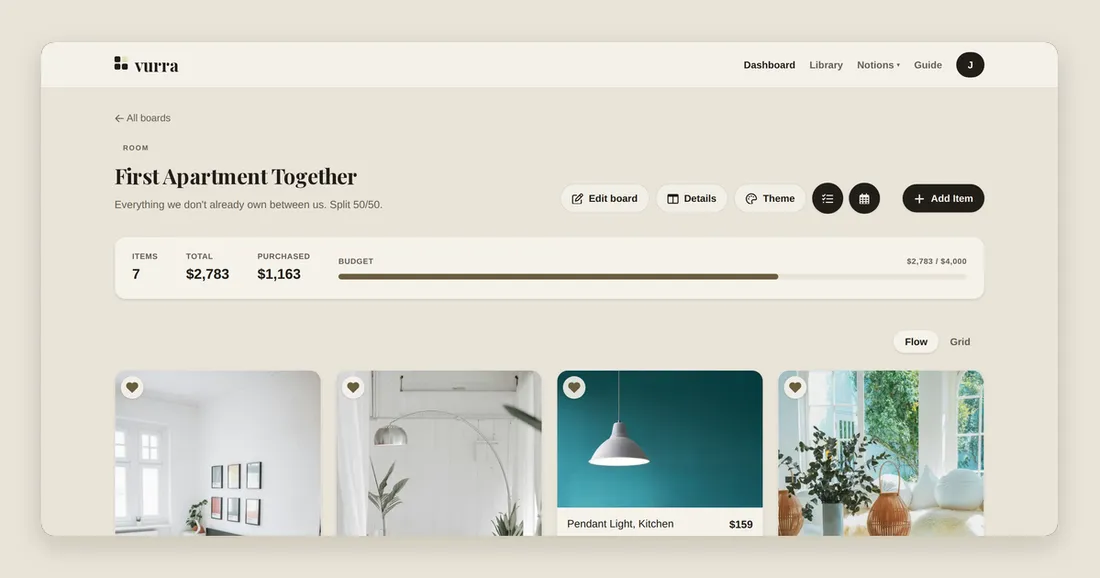
Put every item on one board with a field for when it is needed, one for whether it is arriving free from family, and one for who is paying if there are two of you. Then you can look at just the first-night group and see a total, which is the number that actually has to be available on moving day.
The rest sits there, visible, not urgent, and gets bought when it is cheap.