You Saved Two Hundred Recipes and Cook the Same Six
Everyone who saves recipes from the internet has this problem, and it is not a discipline failure. It is a recognition failure, and it has a specific fix.
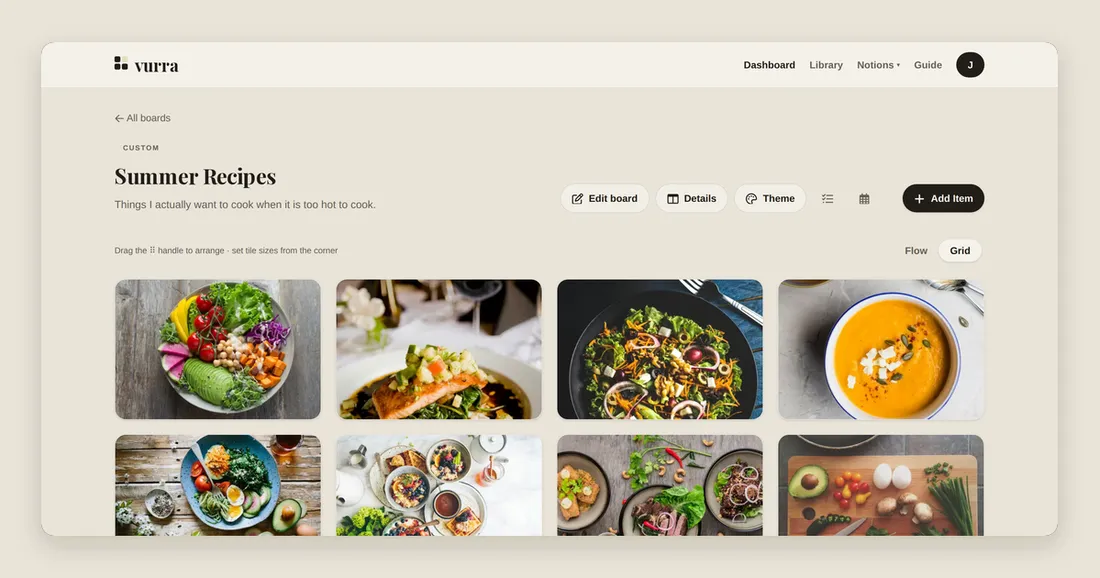
The short version
Saved recipes go uncooked because a list of titles gives you nothing to recognise. You scroll past food you liked because "Charred corn and avocado bowl" is not a picture of dinner. Keep recipes visually, with the time and who liked it attached, and the same collection starts getting used.
There is a folder, or a Pinterest board, or eight hundred Instagram saves, or a browser bookmark directory named “recipes” with subfolders nobody has opened. In it are somewhere between fifty and a thousand recipes, saved deliberately, by someone who genuinely wanted to cook them.
The same six things get cooked.
This is such a universal experience that it gets treated as a personal failing, filed alongside not going to the gym. It is not. It is an interface problem, and it is fixable.
Why a list of titles does not work
When you decide what to cook, you are not retrieving a fact. You are trying to recognise something you want to eat.
Recognition is a visual process. Shown a photograph of a bowl of charred corn and avocado, you know within a fraction of a second whether you want it tonight. Shown the words “Charred Corn and Avocado Bowl”, you have to reconstruct the picture from memory, and if you have not made it, there is no memory to reconstruct from.
So the list gets scrolled, nothing triggers, and you cook the thing you can picture without help, which is one of the six you already make.
The six are not better recipes. They are the ones you have a mental image of.
The three fields that get things cooked
A picture solves recognition. It does not solve the other question, which is whether this particular thing fits tonight.
Time. The single most decisive fact about a weeknight recipe, and reliably buried below eight hundred words of preamble. Extracted onto the card, it turns a collection into something you can filter by the constraint you actually have.
Serves. Cooking for two out of a recipe for six is where the disappointing leftovers come from, and it is worth knowing before you start rather than halfway through.
Who liked it. The field that changes everything and that no recipe app provides, because it is about your household rather than about the recipe. A saved recipe is a guess. A recipe you made, that a specific person asked for again, is a completely different object, and there is nowhere to record the difference.
Cooked is a state, not a tag
The second structural fix is a status. A recipe you have never made, a recipe you intend to make this week, and a recipe you have made and would make again are three different things, and a flat collection cannot tell them apart.
Once they are distinguishable, the collection starts to compound: the “made it, would again” group becomes the actual answer to “what shall we have”, and it grows every time you cook.
That group is the thing you have been trying to build for years by saving recipes. It cannot be built by saving, only by cooking and recording.
Photograph the ones that worked
The last step, and the one that sounds fussy until you do it once. When something comes out well, take a picture of your version and put it on the card.
Your photograph of your version has more pull than the professional shot, because it is a picture of a thing you actually made, at your skill level, in your kitchen, with your plates. It is also proof that it works, which the styled version is not.