In a Home Office, Buy the Chair Before the Desk
Most home office budgets are spent in the wrong order, and the chair is what pays for it. Here is the order that survives eight hours a day, and the four specs that decide each purchase.
The short version
Price the chair first and let the desk take what is left. A chair is the only thing in a home office your body is in contact with for eight hours, it holds resale value, and it has the longest lead time. Desks are close to interchangeable above a low bar; chairs are not.
There is a predictable shape to a first home office budget. Someone decides on a number, spends most of it on a desk they liked the look of, adds a monitor arm and a lamp, and then discovers there is two hundred dollars left for the chair. They buy the two hundred dollar chair. Eight months later they are buying another chair.
This happens because desks are easy to shop for and chairs are not. A desk is a rectangle with a price and a finish, and you can tell whether you like it from a photograph. A chair is a set of adjustments whose value only becomes apparent after about six weeks, at which point the return window has closed. So the desk gets decided first, absorbs the budget, and the chair becomes the remainder.
Reverse it.
Why the chair goes first
It is the only thing you are in contact with. For eight hours a day, the desk supports your monitor and the chair supports you. Above a fairly low bar, one flat surface at the right height is much like another. Chairs vary enormously at every price point.
It holds its value. A good task chair sold second hand after five years recovers a meaningful share of what it cost. A desk does not, because moving a desk is a two person job and everyone knows it. This changes the real cost of buying well: the expensive chair is not as expensive as the sticker says, and the cheap one is not as cheap.
It has the longest lead time. Chairs worth buying are frequently four to eight weeks out, and often longer in a colour that is not black. A desk is usually in stock. If you decide the chair last, you wait for it last, and you spend two months working from a dining chair you told yourself was temporary.
You can try it. This is the argument that actually matters and the one people skip. Chairs are sold in showrooms because sitting in one for ten minutes tells you more than every review you will read. Desks do not need this.
The order that works
- Chair. Decide the number here first, before anything else has a claim on it. Sit in three at the top of your range and one below it. If the cheaper one is fine, you have just found budget for everything else.
- Desk. Now spend what is left. Check the depth: 24 inches will not take a monitor arm and a keyboard comfortably, and you find that out after delivery. Check the thickness against your monitor arm’s clamp range, which is on the arm’s spec sheet and nowhere near the desk’s page.
- Light. A task lamp costs a fraction of either and does more for how the room feels than a nicer desk would.
- Everything else. Shelving, a clock, a second monitor. These are genuinely optional and can be added over months.
The four specs that decide it
Every one of these lives in a table halfway down a product page, and none of them is in the title.
| Spec | Why it decides the purchase |
|---|---|
| Depth | Under 24 inches and a monitor arm plus a keyboard stops being comfortable. |
| Clamp fits | Monitor arms have a maximum desk thickness. Exceed it and the arm does not attach. |
| Lead time | The difference between working properly in a fortnight and in three months. |
| Height range | Chair, desk and your elbows have to agree, and one of the three is fixed. |
Put those four on the item rather than in your head. The point at which they matter is the point at which you have four tabs open and cannot remember which desk was the 24 inch one.
What this looks like as a board
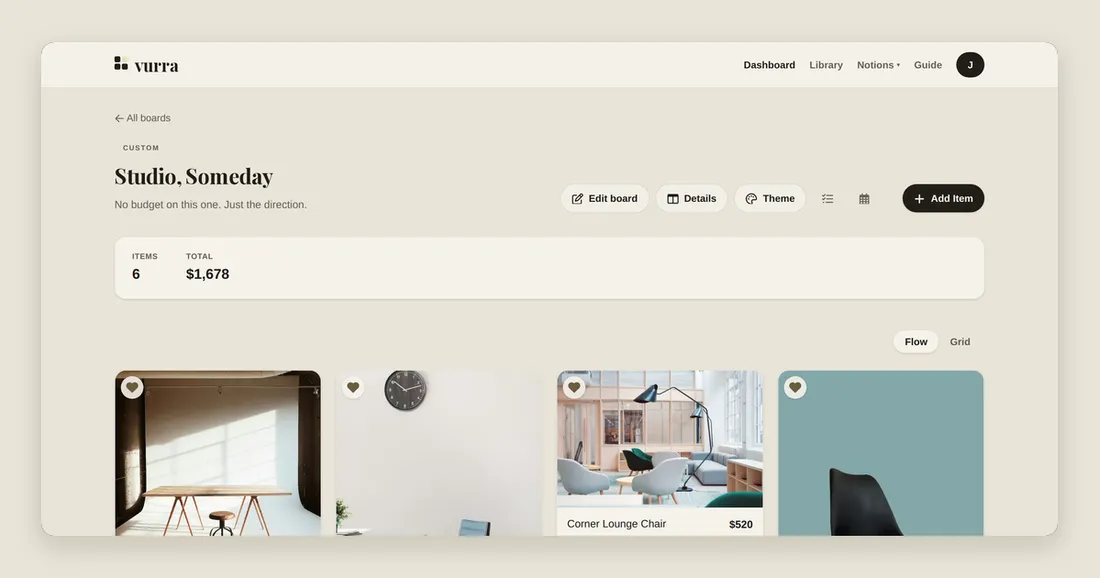
Set the total, add the chair first, and watch the remaining budget move as you add each thing. The value is not the arithmetic, which a spreadsheet does perfectly well. It is that you can see the room while you do it: whether the desk and the shelving are the same wood, whether the lamp disappears against the wall, whether the whole thing looks like one room or four purchases.
A chair you are not ready to buy yet can sit on the board as tracked. It is exactly the kind of purchase where price history matters, because it is expensive, not urgent, and discounted predictably.